Microencapsulation Technology: Why Most Probiotics Fail and How Velo16 is Different
Dr. Chomba Chuma
MD & Founder, Velobiotics
Most probiotic supplements never actually reach your child's gut alive — and as a parent, you deserve to know why. In this article, Dr. Chomba Chuma, MD, breaks down the science of microencapsulation technology, explains why CFU count alone doesn't tell the full story, and reveals how Velo16 is engineered to deliver live probiotics where they matter most.
Microencapsulation Technology: Why Most Probiotics Fail and How Velo16 is Different
By Dr. Chomba Chuma, MD — Founder, Velobiotics
As a paediatrician and a parent myself, I've had countless conversations that go something like this: "Dr. Chuma, we've been giving our child probiotics for months, but nothing seems to be changing." The frustration in those voices is real — and so is the problem. The truth is, most probiotic supplements on the market today are failing your child before they even reach the gut. Not because probiotics don't work. They absolutely do. But because the delivery is broken.
This is a conversation I believe every parent deserves to have. Whether you're navigating your little one's recurring tummy troubles, trying to support their immunity after a course of antibiotics, or simply wanting to lay a strong foundation for lifelong health, understanding how a probiotic gets to work matters just as much as which strains are inside the capsule or sachet. And that "how" comes down to one critical piece of science: microencapsulation technology.
Let's unpack it together — in plain language, backed by solid research, and with your child's wellbeing at the centre of every word.
Section 1: The Science Behind Probiotic Survival — What's Actually Happening Inside Your Child's Tummy
To understand why microencapsulation matters, we first need to take a quick journey through the digestive system. Imagine a tiny live bacterium — one of the beneficial strains you've carefully chosen for your child — sitting inside a probiotic sachet or gummy. From the moment your child swallows it, that microorganism faces a hostile gauntlet.
The Gastrointestinal Obstacle Course
Here's what happens in sequence:
- The mouth and oesophagus — Saliva begins breaking down food and introduces enzymes. Most probiotics pass through here relatively unscathed.
- The stomach — This is where the carnage begins. The stomach is designed to be a killing field for harmful pathogens. It produces hydrochloric acid, dropping the pH to between 1.5 and 3.5 — roughly as acidic as battery acid. Stomach acid resistance is not a marketing term; it's a biological necessity.
- The small intestine — Bile salts and digestive enzymes continue to attack foreign organisms. Even bacteria that survived the stomach face another assault here.
- The large intestine (colon) — This is the destination. The colon is where the vast majority of your gut microbiome lives — trillions of bacteria that influence immunity, mood, digestion, and more.
According to Harvard Health on gut microbiome, the gut hosts an estimated 100 trillion microorganisms, and the diversity and vitality of this community has profound effects on everything from mental health to immune function. For children, whose microbiomes are still developing, the quality of microbial input is especially critical.
"Giving your child a probiotic that doesn't survive the journey to the colon is like posting a letter with no envelope in a rainstorm. The intention was right. The outcome, unfortunately, was not." — Dr. Chomba Chuma
Why CFU Count Is Only Half the Story
Most parents scan probiotic labels for the CFU count — Colony Forming Units — the number that tells you how many live organisms are theoretically in each dose. A higher number feels reassuring. Ten billion CFU sounds impressive. But here's what that number doesn't tell you: how many of those organisms will still be alive when they reach your child's colon.
Clinical research on probiotics consistently shows that without adequate protection, up to 99% of standard probiotic bacteria can be destroyed by stomach acid alone before they ever reach the intestinal tract. That means a product boasting 10 billion CFU could be delivering fewer than 100 million viable organisms to where they're actually needed. And in some cases, far fewer than that.
This is precisely why the National Institutes of Health on probiotics notes that the effectiveness of any probiotic is closely tied to strain selection and the formulation method used — not simply the count on the label.
For more on the fundamentals of gut health science, our dedicated resource section offers a growing library of evidence-based reading.
Section 2: The Problem Parents Face — Why Most Products on the Shelf Fall Short
Let me be direct with you: the probiotic supplement industry is, in many ways, the Wild West. Regulatory frameworks in most countries — South Africa included — do not require manufacturers to prove that their organisms survive digestion before a product reaches store shelves. What's on the label doesn't have to match what's biologically active by the time it reaches your child's gut.
The Three Core Failure Points
1. No protection against stomach acid The majority of budget-friendly probiotic gummies, powders, and tablets use uncoated or minimally processed bacterial strains. These are essentially naked bacteria sent into a biochemical war zone. Without stomach acid resistance built into the formulation, survival rates are dismally low.
2. Instability during storage Live bacteria are sensitive organisms. Heat, moisture, light, and oxygen can all degrade probiotic viability long before the product is consumed. Many over-the-counter products lose significant potency sitting on a warm pharmacy shelf or in a lunchbox on a summer's day.
3. Misleading CFU labelling Some manufacturers list CFU counts at the time of manufacture, not at the time of consumption. By the time a product expires — or even halfway through the shelf life — the actual live organism count may be a fraction of what's printed on the box.
What This Means for Your Child
If the live probiotics delivery is failing at the formulation level, your child may be consuming a product that offers little more than expensive placebo. Worse, parents who try one or two products, see no result, and conclude that "probiotics just don't work for my child" are making a reasonable but misinformed conclusion — because the science of probiotics absolutely works. It's the technology that's been letting them down.
The WHO nutrition guidelines for children emphasise that nutritional interventions for children must be evidence-based and demonstrably effective. In my view, that standard must apply to probiotic supplementation as rigorously as it does to any other nutritional product.
Section 3: The Solution — What Microencapsulation Technology Actually Does
This is where the science becomes genuinely exciting. Microencapsulation is a process by which individual probiotic bacteria — or clusters of bacteria — are coated in a protective shell, typically made from natural polymers such as alginate, cellulose derivatives, or specialised lipid coatings. Think of it as giving each tiny bacterium its own microscopic spacesuit.
How Microencapsulation Works: Step by Step
- Bacterial selection — High-potency, clinically validated probiotic strains are selected based on their specific benefits and their compatibility with the encapsulation process.
- Encapsulation — Using precision technology, each bacterial culture is enclosed within a biocompatible polymer shell. This shell is engineered to remain intact under highly acidic conditions (pH 1.5–3.5) — the conditions your child's stomach creates.
- pH-triggered release — As the encapsulated probiotic moves from the acidic stomach into the more neutral environment of the small intestine and colon (pH 6–7.5), the shell begins to dissolve, releasing the live bacteria exactly where they need to establish themselves.
- Colonisation — Now alive and intact, the organisms begin interacting with the existing gut microbiome, supporting diversity, immune function, and digestive wellbeing.
What the Clinical Research Says
The clinical research on probiotics using microencapsulation is compelling. Multiple peer-reviewed studies have demonstrated that microencapsulated probiotic strains show survival rates 10 to 1000 times higher than their unprotected counterparts when exposed to simulated gastric conditions. A 2019 review published in the Journal of Functional Foods found that microencapsulation significantly improved the viability of Lactobacillus and Bifidobacterium strains — two of the most clinically important genera in paediatric gut health — under gastrointestinal stress conditions.
Furthermore, microencapsulation also addresses the storage stability problem. The protective coating shields bacteria from environmental stressors, meaning CFU count remains stable throughout the product's shelf life — not just at the moment of manufacture.
"Microencapsulation isn't a gimmick. It's the bridge between the promise of probiotics and the reality of what your child's body actually receives. Without it, you're leaving delivery to chance." — Dr. Chomba Chuma
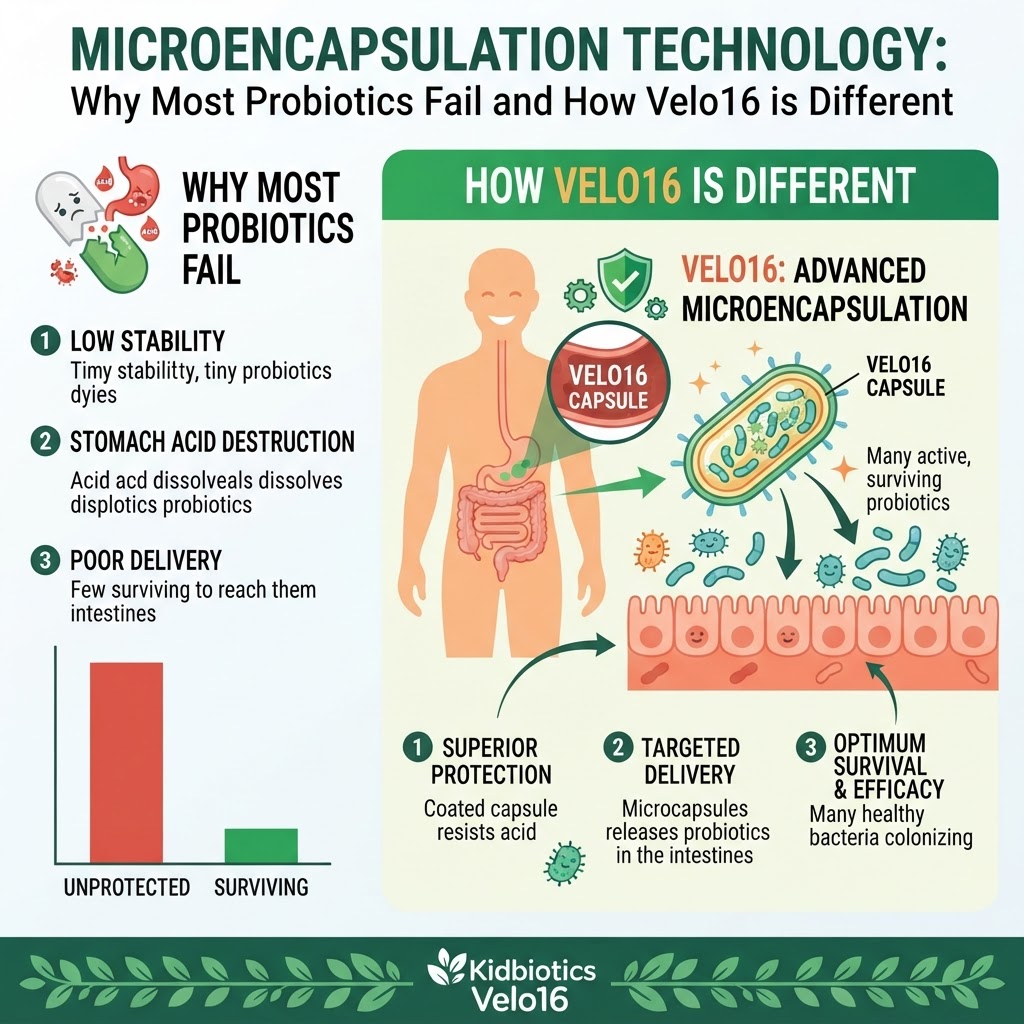
Infographic: Visual summary of key concepts discussed in this article.
Suggested infographic: "The Journey of a Probiotic — Unprotected vs. Microencapsulated" showing a side-by-side visual of an uncoated bacterium being destroyed in the stomach versus a microencapsulated bacterium passing safely through to the colon.
Section 4: Practical Guidance for Parents — Making Smarter Probiotic Choices
Armed with this knowledge, here's what I recommend when evaluating any probiotic for your child:
What to Look for on the Label
- Microencapsulation or enteric coating mentioned — If a product doesn't mention how the bacteria are protected, assume they aren't.
- CFU count at time of expiry, not manufacture — Look for language like "viable through end of shelf life" or "guaranteed CFU at expiry."
- Named strains with clinical research — Vague terms like "probiotic blend" are red flags. Look for specific strain designations such as Lactobacillus rhamnosus GG or Bifidobacterium longum BB536.
- Multi-strain formulations — Diversity matters. Different strains colonise different parts of the gut and offer different benefits.
- Age-appropriate formulation — Children's guts are not miniature adult guts. Strain selection and dosage should reflect paediatric clinical research specifically.
Questions to Ask Your Healthcare Provider
- Is this probiotic formulated with microencapsulation or another delivery protection technology?
- Have the strains in this product been tested in children specifically?
- What CFU count is guaranteed at expiry?
- Are there any interactions with my child's current medications or conditions?
Supporting Probiotic Effectiveness Through Diet
Probiotics work best when they have something to feed on. Prebiotic fibres — found in foods like oats, bananas, garlic, leeks, and legumes — help newly introduced bacteria thrive and colonise. Use our Lunchbox Builder tool to create gut-friendly meals that naturally support your child's probiotic supplementation.
You can also track how your child's gut health is progressing over time using our fun and surprisingly informative Poop Patrol gut tracker — because as any experienced paediatrician will tell you, what comes out tells you a great deal about what's happening inside.
Section 5: Why Velo16 and BioKid Are Different — The Science Made Real
At Velobiotics, we built BioKid Probiotics because we saw a gap that frustrated us both as clinicians and as parents. The science of paediatric gut health is robust and inspiring. The products available to families, however, were often not living up to that science — quite literally.
Velo16 is our microencapsulation technology platform, and it represents everything I've described in this article, applied to a real product designed specifically for children.
What Makes Velo16 Stand Out
- Precision microencapsulation — Each strain in our BioKid formulation is individually encapsulated using our Velo16 process, engineered specifically to withstand the pH conditions of a child's digestive tract.
- Guaranteed live probiotic delivery — Our encapsulation ensures that the bacteria in BioKid are still alive and active when they reach the colon — not just when they leave our facility.
- Clinically validated strains — Every strain selected for BioKid has peer-reviewed clinical research supporting its use in children, covering areas from immunity and digestive regularity to mood and skin health.
- Stable CFU count through expiry — We guarantee our CFU count through the end of shelf life, under recommended storage conditions. What you read on the label is what your child receives.
- No artificial preservatives, colours, or sweeteners — Because protecting your child's gut shouldn't mean loading them with additives that could disrupt it.
- Designed for real South African families — From our flavour profiles to our sachet format, BioKid is built for life as it's actually lived — school lunchboxes, busy mornings, kids who pull faces at medicine.
"I created Velo16 because I wanted every child — not just those whose parents happen to have a medical background — to have access to a probiotic that actually works. That means getting the science right, communicating it honestly, and never cutting corners on delivery technology." — Dr. Chomba Chuma
If you've been spending money on probiotics and wondering why you're not seeing results, I'd encourage you to visit www.velobiotics.com and explore what a properly formulated, microencapsulation-protected probiotic can do for your child's health. The difference isn't just scientific — it's something parents tell us they can see and feel within weeks.
Join the growing community of South African parents who are taking gut health seriously — visit our community hub to share experiences, ask questions, and connect with other families on the same journey.
Conclusion: The Bottom Line for Every Parent Reading This
Here's what I want you to take away from this article:
Probiotics work. But only if they survive the journey.
The stomach is not forgiving. Billions of fragile bacteria, sent into one of the most acidic environments in the human body without any protection, will not make it. And a probiotic that doesn't reach the gut alive is, by definition, not a probiotic — it's just an expensive powder.
Microencapsulation technology is the scientifically validated solution to this problem. It protects live bacteria through the stomach's acid assault, ensures pH-triggered release in the colon, maintains CFU count stability through the product's shelf life, and ultimately delivers on the genuine promise of probiotic supplementation.
As a parent, you deserve products that meet the standard of care I would recommend to any patient in my consulting room. As a doctor, I built Velo16 and BioKid to be exactly that product.
If you have questions about your child's gut health or want to understand more about the gut health science behind our formulations, we're here for every step of the journey.
📌 Related Reading
Explore more resources from BioKid and Velobiotics:
- 🔬 Gut Health Science — The Research Behind BioKid
- 🛒 Shop BioKid Probiotics
- 💩 Poop Patrol — Track Your Child's Gut Health
- 🥗 Lunchbox Builder — Gut-Friendly Meals for Kids
- 👨👩👧 Join Our Community Hub
Dr. Chomba Chuma is a medical doctor and the founder of Velobiotics, creator of the BioKid children's probiotic range. He writes at the intersection of paediatric medicine, nutrition science, and parent education. All content is intended for informational purposes and does not constitute personalised medical advice. Please consult your healthcare provider for guidance specific to your child.
Get gut-smart, one email at a time.
Science made simple, practical tips and member-only offers. No spam, unsubscribe anytime.
By subscribing you agree to receive emails from BioKid (Velobiotics). POPIA compliant. Unsubscribe in one click.