
The Gut-Brain Connection in Children: How Probiotics Improve Focus, Mood and Sleep
Dr. Chomba Chuma
MD & Founder, Velobiotics
Did you know your child's gut and brain are in constant conversation? Discover the science behind the gut-brain axis in kids and learn how probiotics can naturally support better focus, calmer moods, and deeper sleep — backed by research and practical advice from Dr. Chomba Chuma, founder of Velobiotics.
Is Your Child's Gut Affecting Their Mood, Focus and Sleep? The Science Every Parent Needs to Know
If you've ever noticed that your child becomes grumpy, distracted, or struggles to settle at night after a bout of tummy trouble — you weren't imagining things. There is a very real, very powerful biological conversation happening between your child's gut and their brain, and it is influencing far more than digestion.
As a medical doctor and the founder of Velobiotics, I've spent years studying how the microbiome — the trillions of bacteria living in our digestive systems — shapes the way children think, feel, and sleep. What I've found is both fascinating and, for many parents, deeply reassuring: there are practical, science-backed steps you can take to support your child's mental clarity, emotional resilience, and restful nights, starting in the gut.
In this article, I want to walk you through what the research actually says, why so many children today are struggling with focus and mood, and how targeted child wellness strategies — including the right probiotic support — can make a measurable difference.
Section 1: Understanding the Gut-Brain Axis in Children
The term "gut-brain axis" might sound like scientific jargon, but the concept is beautifully straightforward: your gut and your brain are physically and chemically connected, and they talk to each other constantly.
This communication happens through several pathways:
- The vagus nerve — a direct neural highway running from the brainstem to the gut
- Neurotransmitters — chemical messengers like serotonin and dopamine, many of which are produced in the gut
- The immune system — gut bacteria regulate inflammation that directly affects brain function
- The HPA axis — the hormonal stress-response system, which is heavily influenced by gut microbiome composition
"Approximately 90% of the body's serotonin — the neurotransmitter most associated with happiness and emotional stability — is produced in the gut, not the brain. When a child's gut microbiome is out of balance, their neurochemistry is affected too." — Dr. Chomba Chuma
For children, this matters enormously. The gut-brain axis in kids is still developing, making early childhood a critical window during which the microbiome has an outsized influence on neurological development. Research published by the Harvard Health on gut microbiome confirms that disruptions to the gut microbiome can manifest as changes in mood, behaviour, and cognitive performance.
The gut microbiome also plays a key role in producing short-chain fatty acids (SCFAs), which nourish the cells lining the gut wall and support the blood-brain barrier — the protective layer that shields the brain from harmful substances. A compromised gut lining in children has been associated with increased neuroinflammation, which can present as brain fog, irritability, and difficulty concentrating.
Key Neurotransmitters Made in the Gut
- Serotonin — regulates mood, sleep cycles, and appetite
- GABA (gamma-aminobutyric acid) — promotes calm and reduces anxiety
- Dopamine — supports motivation, attention, and learning
- Melatonin precursors — serotonin is a building block for melatonin, the hormone that governs sleep
Understanding this gut-brain connection is the first step in understanding why probiotic support and gut health science are becoming such important pillars of holistic child wellness.
Section 2: The Problem — Why So Many Children Are Struggling Today
Despite growing awareness of children's nutrition, millions of children around the world — including right here in South Africa — are experiencing what I would describe as a microbiome crisis. This isn't alarmist; it's well-documented.
Several modern factors are systematically depleting the diversity and health of children's gut bacteria:
The Usual Suspects
1. Ultra-processed diets The modern children's diet is heavily skewed toward refined carbohydrates, added sugars, artificial colours, and preservatives — all of which feed harmful bacteria and starve beneficial ones. The WHO nutrition guidelines for children are clear that dietary diversity is essential for healthy development, yet most children are falling drastically short.
2. Antibiotic overuse Antibiotics are sometimes lifesaving and absolutely necessary — but they are also indiscriminate, wiping out both harmful and beneficial bacteria. Research shows it can take six months to two years for a child's microbiome to recover after a single course of antibiotics, and in some cases, certain bacterial strains never fully return.
3. Chronic stress and screen time School pressure, social anxiety, and excessive screen exposure activate the stress-response system, which in turn disrupts gut motility and microbiome composition. The gut-brain axis in kids is a two-way street — just as gut health affects the brain, chronic stress harms the gut.
4. Sedentary lifestyles Physical activity promotes healthy gut transit and microbiome diversity. Children who are less physically active tend to have less diverse microbiomes.
5. Caesarean births and formula feeding While neither is avoidable for many families, both can reduce early microbial colonisation compared to vaginal birth and breastfeeding, meaning some children start life with a less diverse microbiome baseline.
The result? We are seeing increasing rates of children who:
- Struggle to focus at school and during homework
- Experience frequent mood swings, anxiety, or emotional outbursts
- Have difficulty falling or staying asleep
- Complain of recurrent tummy aches, bloating, or irregular bowel movements
- Get sick repeatedly due to compromised immune function
As parents, it can feel overwhelming. But here is what I want you to take away: these symptoms are not a personality flaw or a parenting failure. In many cases, they are signals from an imbalanced gut — and that is something we can actually address.
Section 3: What Actually Works — Probiotics, the Gut-Brain Axis, and Child Wellness
The science of probiotics has advanced enormously over the past decade. We now understand that not all probiotics are equal — the strain, the dose, the delivery mechanism, and the combination of bacteria all matter. When it comes to the mood gut connection, focus in children, and sleep and gut health in kids, specific probiotic strains have demonstrated impressive results in clinical research.
Probiotics and Focus in Children
Several studies have examined the relationship between gut microbiome health and cognitive performance in children. A landmark study found that children with greater microbial diversity performed significantly better on tests of working memory and attention than those with low diversity.
Probiotic strains such as Lactobacillus rhamnosus and Bifidobacterium longum have been shown to influence GABA receptor expression in the brain, supporting the kind of calm, focused attention that children need to learn effectively. When the gut is producing adequate neurotransmitter precursors, children are simply better able to concentrate — less distracted, more engaged, and more resilient to frustration.
"I often tell parents: if your child is struggling to focus, before reaching for the next supplement or intervention, let's look at what's happening in their gut. In my clinical experience, addressing gut health frequently leads to noticeable improvements in a child's ability to engage, learn, and regulate their emotions." — Dr. Chomba Chuma
The National Institutes of Health on probiotics acknowledges growing evidence for probiotics' role in supporting cognitive health, though more large-scale paediatric trials are still underway.
Probiotics and Mood
The mood gut connection is perhaps the most studied aspect of the gut-brain axis. Children with dysbiosis (microbial imbalance) often display increased anxiety, irritability, and emotional volatility. This is not coincidental.
When beneficial bacteria are depleted, the gut produces less serotonin and GABA, the brain receives more inflammatory signals, and the stress-response system becomes hyperactive. Conversely, well-studied probiotic strains — sometimes called "psychobiotics" — have been shown to:
- Reduce cortisol levels (the primary stress hormone)
- Increase serotonin production
- Dampen neuroinflammation
- Support emotional regulation and social behaviour
Probiotics and Sleep
Sleep and gut health in kids are intimately connected in ways that many parents don't realise. Here's the key: serotonin produced in the gut is the precursor to melatonin, the hormone that regulates the sleep-wake cycle. If a child's gut isn't producing adequate serotonin due to microbiome imbalance, their melatonin levels may be insufficient to support deep, restorative sleep.
Additionally, gut discomfort — bloating, cramps, irregular bowel movements — can cause physical disruption to sleep, and children are often unable to articulate what's bothering them.
Research has also found that children who take targeted probiotics show improvements in sleep quality, sleep latency (how quickly they fall asleep), and reduced night-time waking — changes that parents and caregivers typically notice within four to eight weeks.
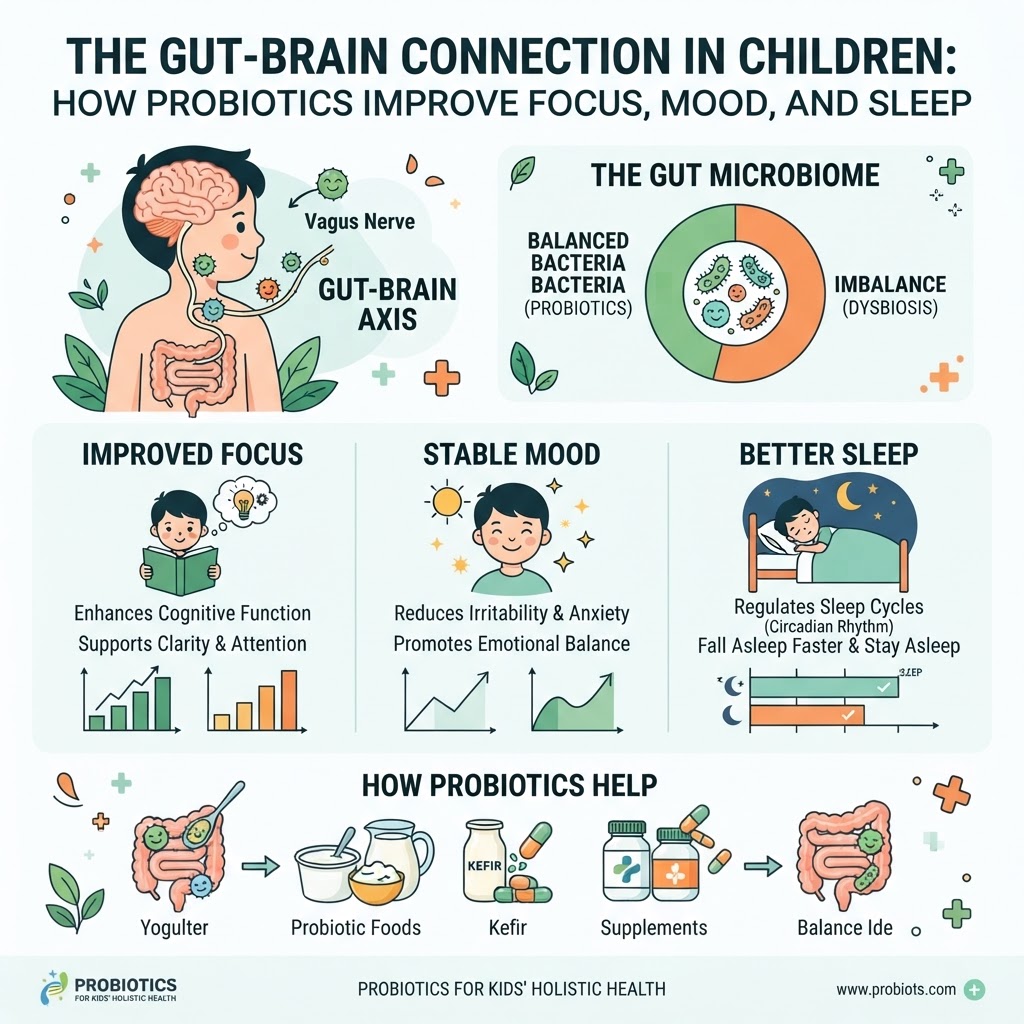
Infographic: Visual summary of key concepts discussed in this article.
Suggested infographic: "The Gut-Brain Axis in Kids" — a child-friendly diagram showing the vagus nerve connection, key neurotransmitters made in the gut, and how probiotics support focus, mood and sleep
Section 4: Practical Steps to Support Your Child's Gut-Brain Health
Knowing the science is empowering, but what parents really need are actionable strategies. Here is a structured approach I recommend for supporting your child's gut health — and by extension, their focus, mood, and sleep.
Step-by-Step: The Gut-Brain Wellness Plan for Kids
-
Introduce a quality, multi-strain probiotic daily. Look for a product that contains well-researched strains like Lactobacillus acidophilus, Bifidobacterium infantis, and Lactobacillus rhamnosus in meaningful colony-forming unit (CFU) counts.
-
Diversify the diet with prebiotic-rich foods. Probiotics need food to thrive — fibre-rich foods are their fuel. Incorporate:
- Oats and whole grains
- Garlic, onion, and leeks
- Bananas (especially slightly underripe ones)
- Lentils and legumes
- Apple slices with the skin on
-
Reduce ultra-processed foods and added sugars. These feed harmful bacteria and promote dysbiosis. Small, consistent changes matter more than perfection.
-
Prioritise sleep hygiene alongside gut support. A consistent bedtime routine, reduced screen time in the hour before bed, and a cool, dark room all support melatonin production. Combined with probiotic support for serotonin pathways, the effect is compounded.
-
Encourage outdoor physical activity. Even 30 minutes of active outdoor play daily supports both microbiome diversity and emotional regulation.
-
Minimise unnecessary antibiotic use in partnership with your doctor, and always follow antibiotic courses with a targeted probiotic protocol to restore gut flora.
-
Track your child's gut health patterns. Use tools like our Poop Patrol gut tracker to monitor your child's bowel habits — the consistency, frequency, and appearance of stools are key indicators of gut health.
-
Plan gut-healthy lunchboxes. Our Lunchbox Builder tool makes it easy to create fibre-rich, probiotic-friendly school lunches your child will actually eat.
Foods to Include More Often
- Plain yoghurt with live cultures
- Kefir (cow's or coconut-based)
- Miso soup (a child-friendly option)
- Sauerkraut or fermented vegetables (small amounts)
- Bone broth (supports gut lining integrity)
- Colourful vegetables and fruits for polyphenols
Signs Your Child's Gut Health Is Improving
- More settled mood and fewer emotional outbursts
- Improved ability to focus during homework or reading
- Faster sleep onset and fewer night wakings
- More regular, well-formed bowel movements
- Fewer complaints of tummy aches or bloating
- Better immune resilience (fewer colds and infections)
Section 5: How BioKid Probiotics Support the Whole Child
At Velobiotics, we developed BioKid Probiotics specifically with the gut-brain axis in kids in mind. As a clinician and a parent myself, I wanted a product that didn't just tick the probiotic box — I wanted something that addressed the full picture of child wellness: cognition, emotional balance, immunity, and sleep.
BioKid Chewable Probiotic Tablets are formulated with a carefully selected blend of clinically studied strains at therapeutic doses. They are:
- Multi-strain — combining Lactobacillus and Bifidobacterium species for broad-spectrum gut support
- Child-appropriate in dosage — calibrated for developing digestive and immune systems
- Free from artificial colours, flavours, and common allergens
- Chewable and great-tasting — making daily compliance genuinely easy for children and parents
- Shelf-stable — no refrigeration required, perfect for school bags and travel
Many of the parents in our community hub share stories of transformation — children who were previously struggling with school focus suddenly more engaged, kids who couldn't settle at bedtime falling asleep with ease, and little ones who seemed perpetually grumpy becoming noticeably calmer and happier.
These aren't miraculous claims. They are the logical outcome of supporting a foundational system — the gut — that governs so much of how a child feels, thinks, and behaves.
"BioKid was born from a simple conviction: that when we give children the right microbial foundation, we give their brains, immune systems, and emotional wellbeing the best possible chance to flourish." — Dr. Chomba Chuma
If you are ready to take a proactive step towards your child's holistic wellbeing, I warmly invite you to explore BioKid Chewable Probiotics for Children and begin the gut-brain wellness journey.
Conclusion: A Happy Gut is a Happy Child
The gut-brain connection is not a wellness trend — it is fundamental biology that has been operating in our children's bodies since birth. What is new is our ability to understand, measure, and support it with targeted interventions.
When a child struggles to focus at school, melts down over seemingly small things, or tosses and turns at night, the gut is often sending a message that deserves our attention. By addressing gut health science thoughtfully — through diet, lifestyle, and quality probiotic support — we can give our children the neurological and emotional foundation they need to thrive.
The evidence is clear. The tools are available. And as parents, we have more power than we realise to shape our children's wellbeing from the inside out.
Start with the gut. Everything else follows.
📌 Related Reading
Explore more resources from the BioKid and Velobiotics family:
- 🔬 Understand the gut health science behind BioKid
- 💩 Track your child's gut health with our Poop Patrol gut tracker
- 🥗 Build a gut-healthy school lunchbox with our Lunchbox Builder tool
- 👨👩👧 Connect with other parents in our community hub
- 🛒 Shop BioKid Chewable Probiotics for Children
Dr. Chomba Chuma is a medical doctor and the founder of Velobiotics. He is passionate about using evidence-based gut health science to support child wellness and family health across South Africa and beyond.
Get gut-smart, one email at a time.
Science made simple, practical tips and member-only offers. No spam, unsubscribe anytime.
By subscribing you agree to receive emails from BioKid (Velobiotics). POPIA compliant. Unsubscribe in one click.