
The Science Behind Children's Gut Microbiome and Why It Matters for Lifelong Health
Dr. Chomba Chuma
MD & Founder, Velobiotics
Your child's gut is home to trillions of microorganisms that shape their immunity, mood, and long-term wellbeing — and the window to build a strong microbiome is shorter than most parents realise. In this expert article, Dr. Chomba Chuma breaks down the science of kids' gut health in plain language, explaining what disrupts the microbiome, what restores it, and how the right children's probiotics can make a measurable difference. If you've ever wondered whether a chewable probiotic is worth it for your child, this article is your answer.
Your Child's Gut Is Talking — Are You Listening? The Science Behind the Children's Microbiome and Lifelong Health
As a medical doctor and the founder of Velobiotics, I've spent years studying one of the most underappreciated systems in the human body — the gut microbiome. And when it comes to children, the conversation becomes even more urgent. The decisions we make in the first decade of a child's life, from what they eat to whether they receive targeted children probiotics, can quite literally shape their health trajectory for the next seven decades.
Parents today are overwhelmed with information — and yet, curiously, most have never been told the full story about what's actually happening inside their child's digestive tract. That changes today.
In this article, I want to walk you through the science in a way that's honest, accessible, and actionable. Because understanding kids gut health isn't just an academic exercise — it's one of the most powerful tools you have as a parent.
Section 1: What Is the Gut Microbiome — and Why Does It Matter So Much in Childhood?
The human gut is home to approximately 38 trillion microorganisms — bacteria, fungi, viruses, and archaea — collectively known as the gut microbiome. This internal ecosystem performs functions so critical that many scientists now refer to it as a "second brain" or even a separate organ in its own right.
According to Harvard Health on gut microbiome, the gut communicates directly with the brain via the vagus nerve — influencing mood, cognition, stress responses, and even behaviour. For children, who are still developing neurologically and immunologically, this connection is especially profound.
But here's what most parents don't realise: the window for building a robust microbiome is remarkably short. Research consistently shows that the microbiome undergoes its most critical development in the first three years of life, with important consolidation continuing through adolescence. The microbial communities established during this period influence:
- Immune system calibration — over 70% of the immune system resides in the gut lining
- Nutrient absorption — including vitamins B12, K2, and short-chain fatty acids
- Inflammatory responses — dysbiosis (imbalance) in childhood is linked to allergies, eczema, and asthma
- Mental health — emerging research connects early microbiome diversity to reduced risk of anxiety and depression later in life
- Metabolic health — including healthy weight regulation and blood sugar balance
How the Microbiome Is Built
A child's microbiome begins forming at birth — or even earlier, during pregnancy. Vaginal delivery seeds the baby with the mother's Lactobacillus-rich flora. Breastfeeding introduces human milk oligosaccharides (HMOs), which act as prebiotics to feed beneficial bacteria. Introduction of solid foods marks another pivotal shift.
By the time a child reaches school age, their microbiome should be rich in diversity — housing hundreds of different bacterial species working in synergy. The National Institutes of Health on probiotics confirms that specific probiotic strains have demonstrated efficacy in supporting this balance, particularly in children whose microbiomes have been disrupted.
You can learn more about the gut health science underpinning our approach at Velobiotics.
Section 2: The Modern Threats to Your Child's Gut — What Parents Are Up Against
Here's the difficult truth: modern life is extraordinarily hostile to a child's microbiome. Despite our best intentions as parents, our children's gut health faces daily threats that simply didn't exist a generation ago.
"I see it in my clinic constantly — children presenting with recurrent illness, skin flare-ups, or digestive complaints, and when we dig deeper, the common thread is almost always a compromised gut microbiome. The good news is that it's correctable." — Dr. Chomba Chuma, MD
The Top Microbiome Disruptors in Children
1. Antibiotic Overuse Antibiotics are lifesaving medicines — but they are indiscriminate. A single course of broad-spectrum antibiotics can reduce microbiome diversity by up to 90%, with some strains taking months or years to recover. Children in South Africa and globally receive an average of 10–20 antibiotic courses before their 18th birthday.
2. Ultra-Processed Foods The WHO nutrition guidelines for children clearly advocate for whole-food diets rich in fibre — yet the reality in most households is very different. Ultra-processed foods are low in fibre, high in artificial additives, and actively feed pathogenic bacteria at the expense of beneficial ones.
3. Chronic Stress and Poor Sleep The gut-brain axis runs in both directions. Academic pressure, screen time, social stress, and insufficient sleep all elevate cortisol — which directly suppresses beneficial gut bacteria and compromises the intestinal barrier.
4. Caesarean Section and Formula Feeding Children born via C-section miss the initial microbial seeding from the birth canal. Formula-fed infants lack the HMOs found in breast milk. Neither of these is a parenting failure — but both mean the microbiome may need extra support.
5. Sanitised Environments The "hygiene hypothesis" — now better understood as the "old friends" hypothesis — suggests that reduced exposure to diverse microorganisms in overly sanitised urban environments contributes to the epidemic of allergic and autoimmune conditions in children.
The cumulative effect of these pressures is a generation of children with less diverse, less resilient gut microbiomes than any previous generation — with measurable consequences for immune support in kids, mental wellbeing, and long-term disease risk.
Section 3: What Actually Works — The Science of Restoring and Supporting Kids' Gut Health
The encouraging news is that the microbiome is remarkably responsive to intervention — particularly in children. The key is understanding what works and why, rather than reaching for any product with "probiotic" on the label.
The Evidence for Probiotics in Children
A well-formulated probiotic works by introducing live beneficial microorganisms into the gut in sufficient numbers to confer a measurable health benefit. The operative word is sufficient. Many products on the market fail at this most basic level — either because they contain too few colony-forming units (CFUs), too few strains, or because the bacteria are killed off before they ever reach the gut.
This is where strain diversity and delivery technology become critical.
Why Strain Diversity Matters
Different bacterial strains colonise different regions of the gut, perform different functions, and support different aspects of health. A probiotic containing only one or two strains is like hiring a single tradesperson to build an entire house.
BioKid Chewable Probiotics are formulated with 12 strains — a carefully selected blend of Lactobacillus and Bifidobacterium species, chosen specifically for their documented benefits in children. This multi-strain approach supports:
- Diverse microbial colonisation across the digestive tract
- Broader immune support for kids
- More robust competitive exclusion of harmful bacteria
- Enhanced production of short-chain fatty acids and digestive enzymes
The Delivery Problem — and How Microencapsulation Solves It
Here is a fact that should concern every parent buying probiotics: most probiotic bacteria are dead before they reach your child's gut. Stomach acid, bile salts, and heat during manufacturing or storage kill the vast majority of unprotected bacterial cells.
At Velobiotics, we developed Velo16 technology — our proprietary microencapsulation process that wraps each bacterial cell in a protective lipid coating. This coating:
- Shields bacteria from stomach acid during transit
- Protects viability through the manufacturing process
- Ensures controlled release in the small and large intestine, where colonisation occurs
- Significantly extends shelf stability without refrigeration
Microencapsulation isn't a marketing term — it's a well-established pharmaceutical technique now being applied to next-generation probiotics. The result is dramatically higher rates of bacterial survival and gut colonisation compared to unprotected formulations.
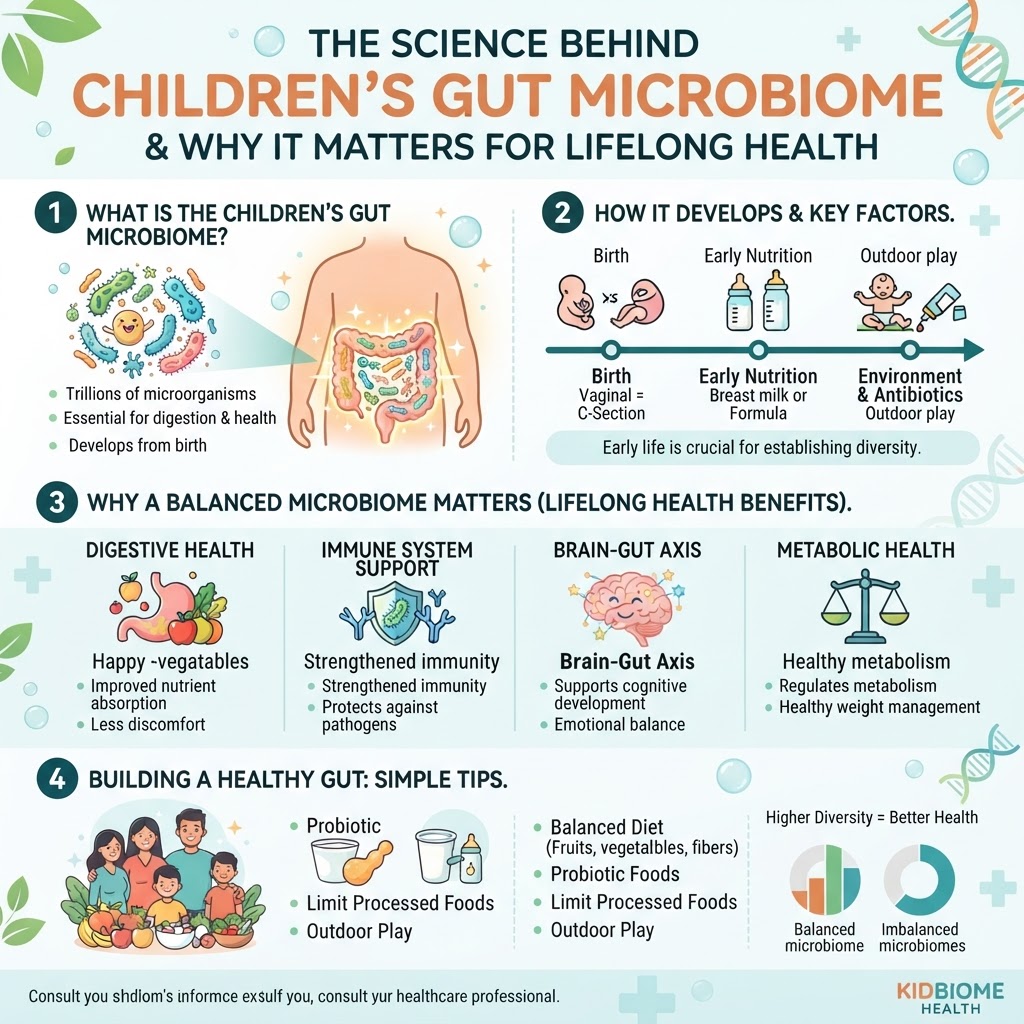
Infographic: Visual summary of key concepts discussed in this article.
Suggested infographic: "Journey of a BioKid Probiotic from Tablet to Gut" — illustrating microencapsulation, stomach acid transit, intestinal release, and colonisation sites. Include strain names and key benefits.
Section 4: Practical Steps to Support Your Child's Gut Health Every Day
Supplementing with a quality chewable probiotic is one powerful tool — but it works best as part of a broader gut-supportive lifestyle. Here are evidence-based steps every parent can take:
1. Feed the Microbiome First
Prebiotics are the fibres that feed beneficial bacteria. Prioritise these foods in your child's daily diet:
- Bananas (especially slightly underripe ones — high in resistant starch)
- Oats — a brilliant breakfast prebiotic
- Garlic and onions — rich in inulin
- Legumes — lentils, chickpeas, and beans
- Colourful vegetables — aim for at least five different colours per week
Our Lunchbox Builder tool is a free resource on the BioKid platform that helps parents design gut-friendly meals their kids will actually eat.
2. Minimise Unnecessary Antibiotic Use
Always consult your doctor — but don't hesitate to ask whether antibiotics are truly necessary. Viral infections (the common cold, most sore throats, most ear infections) do not respond to antibiotics. When antibiotics are necessary, begin probiotic supplementation on the same day and continue for at least four weeks after the course ends.
3. Prioritise Sleep
Children aged 5–12 require 9–11 hours of sleep per night. Sleep is when the gut repairs its lining, the immune system consolidates its responses, and the microbiome rebalances. A consistent bedtime routine is one of the most underrated gut health interventions available.
4. Reduce Ultra-Processed Food
You don't need to be perfect — but aim for the 80/20 principle: 80% whole, minimally processed foods, 20% flexibility. Swap one ultra-processed snack per day for a whole food alternative and you'll meaningfully shift your child's microbial environment within weeks.
5. Get Outside and Into Nature
Dirt, grass, and natural environments expose children to diverse microbial communities that train the immune system. Outdoor play isn't just good for mental health — it's literally medicine for the microbiome.
6. Track Gut Health Consistently
One of the most useful habits parents can develop is monitoring their child's stool — the most visible window into gut health. Our free Poop Patrol gut tracker uses the Bristol Stool Chart to help parents identify patterns, flag concerns, and track improvement over time.
Section 5: BioKid Chewable Probiotics — Designed for Children, Backed by Science
As a clinician and a parent myself, I understand the tension between wanting to do everything right and having limited time, energy, and budget. That's precisely why we developed BioKid Probiotics — to give parents one reliable, science-backed tool that does the heavy lifting.
BioKid Chewable Probiotics were formulated with the specific challenges of children's gut health in mind:
- 12 carefully selected strains — for comprehensive microbiome support
- Velo16 microencapsulation technology — ensuring bacteria survive the journey to your child's gut
- Chewable tablet format — no capsule swallowing, no fridge required, easy for children to take
- Child-appropriate CFU dosing — evidence-aligned for ages 3 and above
- No artificial colours, flavours, or sweeteners — because what we leave out matters as much as what we put in
- Immune support for kids — with strains specifically documented to modulate childhood immune responses
"When I formulated BioKid, I asked myself one question: if this were going into my own child's body every day, would I be satisfied with every single ingredient and every single process? The answer had to be yes — and that's the standard we hold ourselves to." — Dr. Chomba Chuma, MD
Children who take BioKid Chewable Probiotics consistently as part of a gut-supportive lifestyle may experience:
- Fewer episodes of seasonal illness
- Improved digestive regularity and comfort
- Reduced severity and duration of antibiotic-associated diarrhoea
- Better skin clarity (particularly in children prone to eczema)
- Improved mood stability and focus — via the gut-brain axis
These are not promises — they are outcomes documented in peer-reviewed literature for multi-strain probiotics using targeted delivery technology, and they are outcomes we hear about regularly from families in our community hub.
You can purchase BioKid Chewable Probiotics directly from our website, with South African nationwide delivery.
Conclusion: The Investment That Pays for a Lifetime
The science is no longer ambiguous. A child's gut microbiome is not a peripheral health concern — it is central to almost every dimension of their wellbeing, from how often they get sick to how well they learn, how they feel, and what chronic diseases they may or may not develop decades from now.
The good news — and I want to leave you with this — is that the microbiome is not fixed. It is dynamic, responsive, and remarkably resilient, especially in children. With the right nutritional foundation, lifestyle habits, and targeted supplementation using quality children probiotics with proven delivery technology, you can meaningfully shift your child's gut health trajectory.
You don't need to be a scientist to do this. You just need the right information and the right tools.
That's what BioKid is here to provide.
📌 Related Reading
Explore these resources on the BioKid platform to continue your gut health journey:
- 🔬 Gut Health Science — Deep-dive into the research behind our formulations
- 💩 Poop Patrol Gut Tracker — Monitor your child's digestive health with our free interactive tool
- 🥗 Lunchbox Builder — Create gut-friendly, kid-approved meals in minutes
- 👨👩👧 Our Community Hub — Connect with other parents and share your BioKid journey
- 🛒 BioKid Chewable Probiotics — Shop our flagship children's probiotic
This article was written by Dr. Chomba Chuma, MD, Founder of Velobiotics. It is intended for educational purposes and does not constitute personalised medical advice. Always consult your healthcare provider regarding your child's specific health needs.
Get gut-smart, one email at a time.
Science made simple, practical tips and member-only offers. No spam, unsubscribe anytime.
By subscribing you agree to receive emails from BioKid (Velobiotics). POPIA compliant. Unsubscribe in one click.