
Why Does My Child Get Sick Every Month? A Gut Health Guide
Dr. Chomba Chuma
MD & Founder, Velobiotics
Why does my child get sick every month? Discover the gut-immunity link, picky eating triggers, and simple steps to help your child bounce back stronger.
Why Does My Child Get Sick Every Month? Understanding the Gut-Immunity Link
If you've typed "why does my child get sick every month" into a search bar at 2am while nursing a feverish toddler, you are far from alone. This is one of the most common worries South African parents bring to my practice. The good news is that frequent illness is rarely random — and a surprising amount of the answer lies in your child's gut.
In this article, we'll unpack what's considered normal, what's not, and why gut health plays such a central role in how often your child catches colds, tummy bugs and school-term sniffles.
Why Does My Child Get Sick Every Month? The Gut Connection Parents Overlook
When parents ask me why does my child get sick every month, they're often expecting an answer about germs at school or weak willpower around hand-washing. Those factors matter, but they're only part of the picture.
A huge proportion of your child's immune defences are trained and housed in the gut. If the gut microbiome — the trillions of bacteria living in the digestive tract — is out of balance, the immune system doesn't get the right signals to respond efficiently to everyday germs.
Research suggests that up to 70% of the immune system resides in gut-associated lymphoid tissue, making gut health a central factor in how often children fall ill. — National Center for Complementary and Integrative Health (NCCIH)
This is why two children in the same classroom, exposed to the same virus, can have very different outcomes. One shrugs it off; the other is off school for a week.
The usual suspects parents blame
- New daycare or school environment
- "Just unlucky this term"
- Not enough vitamin C
- Weather changes
These can play a small role, but they rarely explain a true pattern of monthly illness on their own.
What's "Normal" vs What's Not: How Many Colds Should a Child Get?
Before panicking, it helps to know what paediatricians consider typical. Young children, especially those under six, have immature immune systems that are still "learning" from every exposure.
According to the American Academy of Pediatrics, it's common for healthy young children to have:
- 6–8 colds per year in the first few years of school or daycare
- Slightly more frequent illness during the first winter in a new daycare setting
- A gradual drop in frequency as they get older and build immune memory
Frequent, uncomplicated colds in young children are common and are not automatically a sign of a weak immune system, though persistent patterns are worth discussing with a doctor. — American Academy of Pediatrics, HealthyChildren.org
So if your child gets sick every month during their first year of preschool, that may simply be their immune system doing its job of learning. But if illnesses are severe, prolonged, or paired with poor growth, digestive symptoms or extreme fatigue, it's time to speak to your paediatrician.
Signs worth flagging to your doctor
- Illness lasting longer than 10–14 days repeatedly
- Fevers that spike very high or recur often
- Chronic tummy troubles alongside respiratory infections
- Visible fatigue, irritability or poor concentration at school
If several of these sound familiar, our guide on children's digestive health is a useful next read.
The Gut-Immune Link: Why So Much Immunity Starts in the Belly
Here's the science in plain language. The gut lining is lined with immune cells that constantly sample what's passing through — food, bacteria, viruses. A diverse, balanced population of gut bacteria helps "train" these immune cells to respond appropriately: attacking real threats, tolerating harmless substances.
When gut bacteria are imbalanced — due to low-fibre diets, picky eating, antibiotics, or stress — this training process is disrupted. The result can be an immune system that's either underreactive (frequent infections) or overreactive (allergies, sensitivities).
This is a major reason why does my child get sick every month is often less about bad luck and more about gut ecosystem health.
Three gut-related reasons for frequent illness
- Low microbial diversity — fewer "good" bacteria species to compete with harmful microbes
- Weakened gut lining — allows irritants through, triggering low-grade immune activation
- Poor short-chain fatty acid production — these compounds, made by gut bacteria from fibre, directly support immune signalling
For the full science on this ecosystem, see The Science Behind Children's Gut Microbiome.
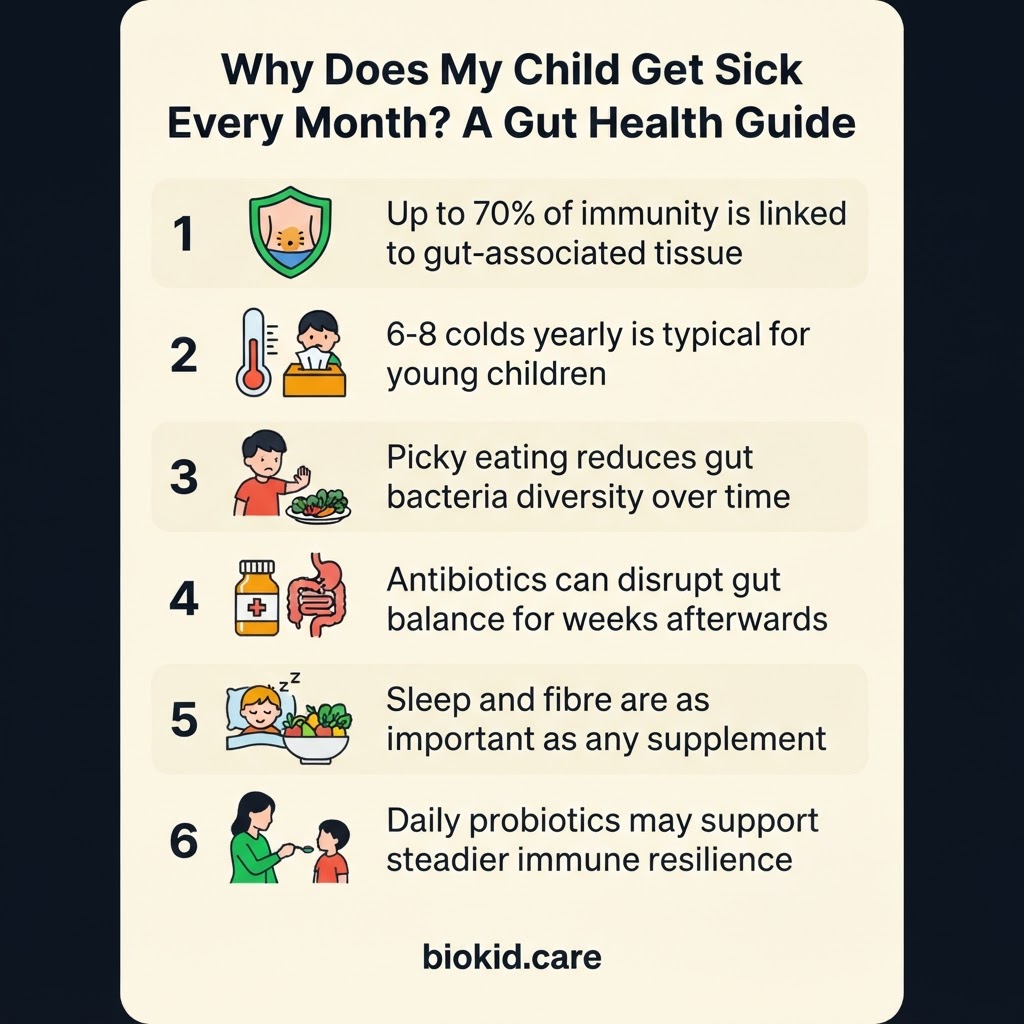
Why your child's gut health may explain those monthly sick days — and simple steps to help.
Picky Eating, Poor Sleep and Lunchbox Gaps: Hidden Triggers
Three everyday factors quietly feed the cycle of monthly illness, and most parents don't connect the dots.
Picky eating
Fussy eaters often avoid fibre-rich vegetables, legumes and fermented foods — exactly the fuel gut bacteria need to thrive. Over time, this narrows microbial diversity, which is associated with a less resilient immune response.
- Offer small amounts of varied textures regularly, even if refused
- Involve children in simple food prep to build familiarity
- Pair new foods with familiar favourites
Poor sleep
Sleep and immunity are deeply linked. During deep sleep, the body produces infection-fighting proteins and the gut lining repairs itself. Chronic sleep disruption is associated with lower immune resilience in children.
Lunchbox gaps
A lunchbox heavy in processed, low-fibre snacks and light on vegetables, fruit or wholegrains gives gut bacteria little to work with for a full school day. Our deep dive on what your child's lunchbox says about their gut health breaks this down practically.
A quick lunchbox audit
- Is there at least one fibre source (fruit, veg, wholegrain)?
- Is there a protein source to support steady energy?
- Are added sugars minimal?
- Is there variety across the week, not just the same three items on repeat?
After Antibiotics: Why Recovery Matters for Fewer Sick Days
Antibiotics are sometimes necessary and can be genuinely important for managing bacterial infections — always follow your paediatrician's guidance. But antibiotics don't distinguish between harmful and helpful bacteria, and a course can significantly reduce gut microbial diversity for weeks afterwards.
This is one of the most overlooked reasons parents ask why does my child get sick every month, particularly if their child has had repeated antibiotic courses in a short period.
Supporting recovery after a course of antibiotics
- Continue a fibre-rich diet to feed remaining good bacteria
- Consider a children's probiotic supplement, ideally one designed to survive stomach acid — see our explainer on why stomach acid kills most probiotics
- Prioritise consistent sleep and reduced sugar during recovery weeks
- Always speak to your paediatrician about timing and suitability of any supplement alongside antibiotics
Many parents find a well-formulated chewable probiotic, like the BioKid Chewable Probiotics, a simple way to support gut rebalancing during this vulnerable window. For strain-specific detail, our article on 12 clinically-proven probiotic strains is worth a read.
Practical Steps to Help Break the Sick-Every-Month Cycle
If you're tired of asking why does my child get sick every month every single term, here is a practical, non-overwhelming checklist to work through gradually.
Daily habits
- Aim for 2–5 servings of fruit and vegetables daily, varied in colour
- Include a fermented food where possible — plain yoghurt, kefir, or soft cheese
- Protect consistent sleep and wake times, even on weekends
- Encourage regular handwashing without turning it into a source of anxiety
Weekly habits
- Plan lunchboxes ahead to avoid the "whatever's in the cupboard" trap
- Include at least one wholegrain swap (brown rice, oats, wholewheat wraps)
- Limit ultra-processed, high-sugar snacks to occasional treats
Supplement support
A daily children's probiotic, chosen carefully, may help support a more resilient gut-immune environment over time. Our parent's buying guide walks through what to look for — strain count, survivability, and sugar content.
A balanced, fibre-rich diet combined with adequate sleep is associated with stronger immune resilience in children, more so than any single supplement alone. — World Health Organization, nutrition guidance
Think of probiotics as one supportive piece of a broader puzzle — not a stand-alone fix.
When to See a Paediatrician
Most frequent illness in young children settles with time, gut support and good habits. However, some patterns need professional attention.
Speak to your paediatrician if your child has:
- More than one serious infection requiring antibiotics per month
- Poor weight gain or growth alongside frequent illness
- Persistent digestive symptoms — review our Bristol Stool Chart guide to track patterns before your appointment
- Visible impact on school performance, mood or energy — see our piece on gut health and school performance
For general reassurance and red-flag symptoms, the Mayo Clinic's child health resources and HealthyChildren.org from the AAP are trustworthy references to read alongside your doctor's advice.
Your simplest first step
You don't need to overhaul your entire household overnight. If you take away one thing from this article, let it be this: start supporting your child's gut consistently, and give it time.
- Add one extra fibre-rich food to today's lunchbox
- Protect bedtime this week, even by 20 minutes
- Consider a daily children's probiotic as a simple, consistent habit
The BioKid Chewable Probiotics were formulated specifically to support children's gut and immune balance in an easy, sugar-conscious chewable — a small daily habit that may help, over weeks and months, reduce how often you're left asking why does my child get sick every month.
Want more practical, science-backed parenting guidance like this? Subscribe to the BioKid newsletter for monthly tips on gut health, immunity and happier, healthier school terms.
Get gut-smart, one email at a time.
Science made simple, practical tips and member-only offers. No spam, unsubscribe anytime.
By subscribing you agree to receive emails from BioKid (Velobiotics). POPIA compliant. Unsubscribe in one click.